Disclaimer
This entry contains information known to us from a variety of sources but may not include all the information currently available. Please be in touch if you notice any inadvertent mistakes in our presentation or have additional knowledge or sources to share. Thank you.
Archive
AIU Boys School at Baghdad, Iraq
Alliance Israélite Universelle Boys School in Baghdad (בגדד, بغدد), Iraq (עיראק, العراق).
Description
In 1864, the Alliance Israélite Universelle opened its first school in Baghdad as an elementary and middle school for boys. The school closed due to religious opposition, but reopened eight years later with the financial support of Sir Albert (Abdulla) David Sassoon. In 1902, the building was expanded by Menahem Daniel. In 1906, additional wings were built and were named after Narsis Levin, the head of the AIU.
The schools taught secular ideas which the Jewish rabbinate originally opposed, until Rabbi 'Abd Allāh Somekh sent his own sons to the school. In 1935 an additional property was added to the school to accommodate growth. The building was located in the Torat neighborhood and was two storeys. The first storey was a synagogue while the second was the school. Beginning in the late 1800s, Alliance graduates opened up new trade horizons for the community in the Far East. During the British Mandate Alliance graduates formed the basic nucleus of government offices and clerical posts. In the 1930s and 40s, some of the AIU schools in Baghdad organized Hebrew literary societies which promoted Jewish nationalism and became linked to the Zionist movement. The AIU emphasized European languages and modern sciences in their curriculum. After completing one year of their middle school studies, students received the French certificat d'etudes. In 1950 the school had 20 classes, 25 teachers and 988 students [1][3].
Baghdad was home to the largest Jewish community in Iraq possibly from as early as its founding in the eighth century. By 1908, the Jews of Baghdad numbered around 53,000, about a third of Baghdad's total population. Jews lived in many quarters including al-Tawrat, Tahat it-Takyah, Abu Saifan, and Suq Hannun. Although Jews were involved in local politics, new tensions began to rise between Jews and Muslims, leading to an anti-Jewish riot on October 15, 1908. World War I forced many Jews to flee the city. In 1948, the Jewish community in Baghdad numbered around 77,000, however the Jewish community began to fear life in Baghdad after the Farhūd. The Farhūd was a pogrom on June 1, 1941 that left 130 Jews dead and caused devastating property damage. The Farhūd inspired the growth of Zionism and Communism among a minority of Jews in Baghdad who felt increasingly disconnected from the Iraqi state. Bombings throughout the 1950s further estranged the Jewish community only about 6,000 Jews remained in Iraq by 1952 due to mass immigration to Israel, Europe, the United States and Canada. The Jewish community endured further violence throughout Saddam Husayn's regime, and in 2003 the last synagogue in Baghdad had closed [2][4].


Sources
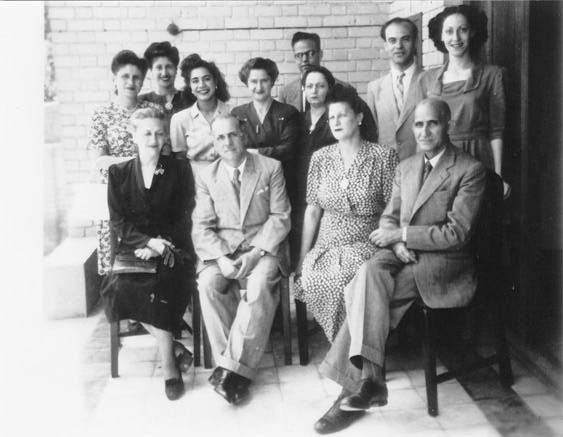
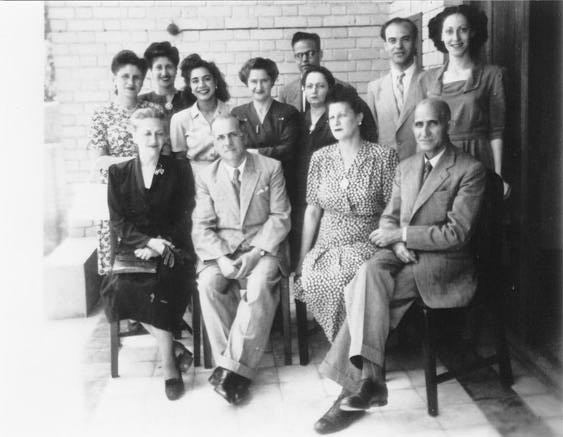
[1] "French teachers and directors at the Alliance schools, in Baghdad, taken in 1949. From left to right: 1st row:Mrs Sabagh; Mr Laredo (the director of the boys school); Mrs Laredo (the headmistress of the girls' school, Laura Kadoury); Mr Sabagh, 2nd row:Melle Totah (Mme Elkebir); Mme Barmaymon; Melle Rachel Mahlab; Mme Shohet; Mme ...?, 3rd row:Mr Tarrab; Mr Barmaymon; Melle Flora Hay," Dangoor.com, The Scribe, 1949, http://www.dangoor.com/70p013.jpg.
[2] Yaron Ayalon; Ariel I. Ahram, "Baghdad," Encyclopedia of Jews in the Islamic World, Executive Editor Norman A. Stillman, Brill Online, 2014, Reference, Wellesley College, 19 June 2014 <http://referenceworks.brillonline.com/entries/encyclopedia-of-jews-in-the-islamic-world/baghdad-SIM_000468>.
[3] Jews of Babylonia from Geonic Times until Today, p. 294.
[4] Dispersion & Liberation Album: Jewry of Iraq
See also:
Dispersion & Liberation Album: Jewry of Iraq
Goldstein-Sabbah, S.R. "Jewish Education in Baghdad: Communal Space vs. Public Space."