Disclaimer
This entry contains information known to us from a variety of sources but may not include all the information currently available. Please be in touch if you notice any inadvertent mistakes in our presentation or have additional knowledge or sources to share. Thank you.
Archive
Synagogue, Testour, Tunisia
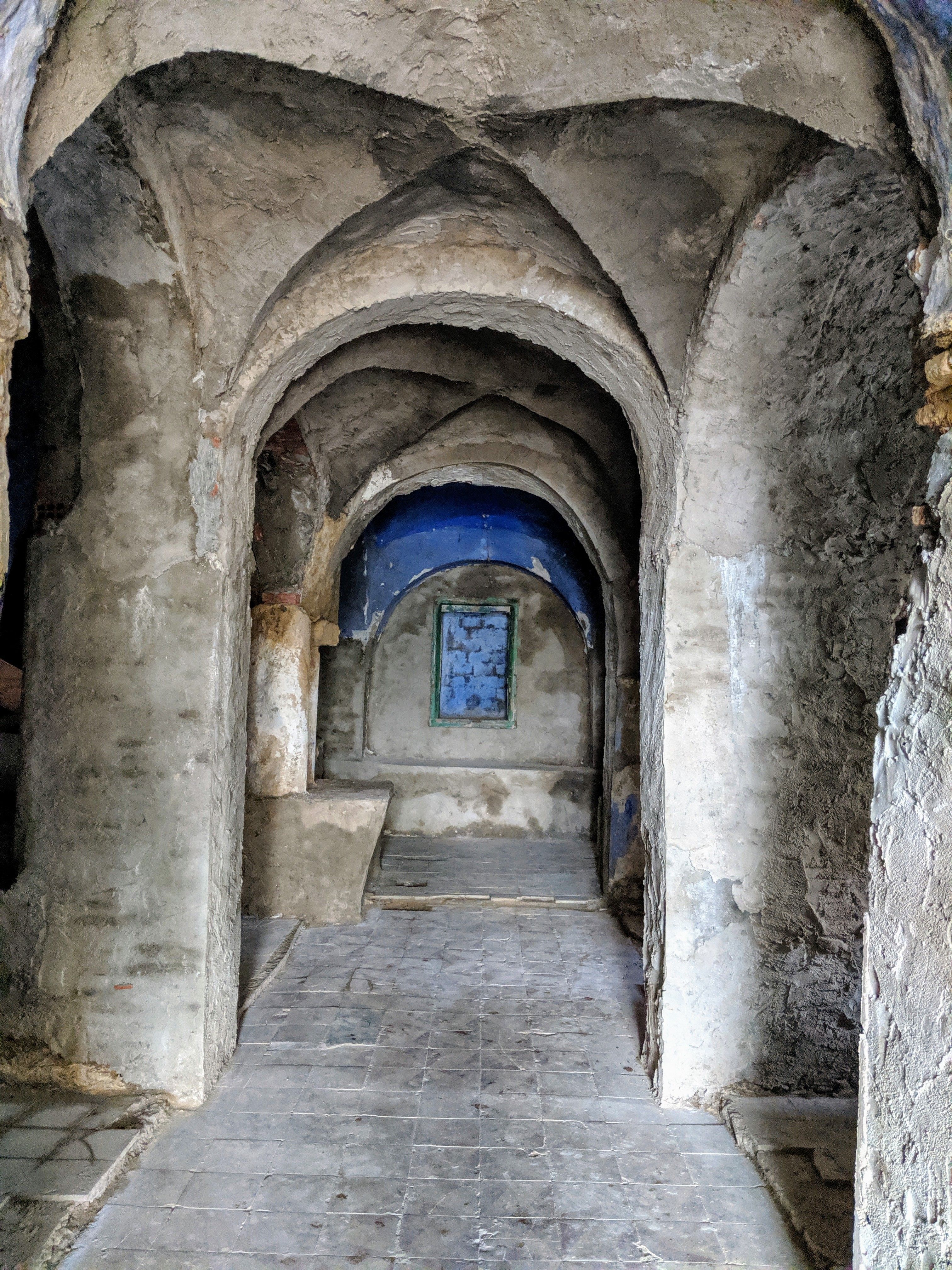
Newly discovered, the synagogue of Testour, Tunisia (“the synagogue of Hiding”) dates back to the era of Muslim and Jewish expulsion from the Andalusian region of Spain in the eighteenth century [1]. Today, its ruins remain, serving as a visual reminder of the sizeable Jewish community that once existed and the lasting impact they have had on Testour’s development and identity [2].
Description
History of the Synagogue at Testour
The synagogue was built in the eighteenth century in the Andalusian style, similar to the Muslim houses and other buildings in the village. It was a low structure with many vaults [3].
On April 5, 1910 the Tunisian order issued a decree to establish a committee that would manage the community of Testour, functioning similarly to the charity committees of other Tunisian communities. The Relief and Charity Committee, as it was called, was responsible for providing assistance to needy families, as well as maintaining the local synagogue [4].
History of Testour, Tunisia
Testour (Arabic: تستور), meaning “Holy Land” in Sumerian, is a small town located in northern Tunisia in the hills of the Medjerda Valley just 20 kilometers (12 miles) southwest of Medjez el Bab and 80 kilometers (50 miles) southwest of Tunis [5]. It was formerly a Roman village known as Tichilla, meaning “the green grass,” given its location in the mouth of the Siliana valley. It was rebuilt at the beginning of the 17th century (around 1609) by Muslim refugees from the Andalusia region of Spain, expelled after the Moors were defeated during the Spanish Inqusition [6]. Some of the wealthy immigrants settled in Tunis, but those who could not afford to resettle there had to ask the Ottoman government for land, and they were granted the old Roman ruins of Tichilla, now called Testour [7]. It then became one of the greatest Moorish towns and one of the oldest towns in Tunisia [8]. Testour was not only a Muslim town, and was into the 20th century a town with a substantial Jewish community [9].
Architecture of Testour
The Muslim refugees from Andalusia brought architectural traditions from Spain with them, giving Testour a distinctive character in building and layout. The urban fabric of Testour is defined by adobe-tiled roofs, and grid layout with a central square and commercial area [10]. Even the Great Mosque’s minaret resembles the Aragonese steeple from southern Spain [11]. Testour is one of the best examples of Andalusian architecture found anywhere in Tunisia. Many structures remain from the seventeenth and eighteenth centuries, including mosques, a synagogue, and the Jewish cemetery,serving as a testament to its history and unique blend of influences [12].
Demography
The total population of Testour reached its height around 1730, with 3,000 total people which included 600 Jews. Civil wars in the eighteenth century and cholera epidemics in the nineteenth diminished the entire population. From 1830 on economic difficulties forced many to move to Tunis. Around 1880, just before the French established their protectorate, Testour had about 200 Jews [13]. The population continued to drop from 156 in 1909, 107 in 1936, to 91 in 1946. The Jewish population ceased to exist after the French withdrew in the 1950s because of the mass migration to Israel [14].
Current News
Recently, a combined lack of maintenance, resources, and awareness has jeopardized the future of historic Testour, compounded by the loss of historical structures through demolitions. Through planning, conservation, community outreach, and tourism development, advocates hope to conserve and revitalize the town to fit Testour’s modern needs. Particularly, infrastructure and services for tourists and pilgrims is especially needed and has the potential to both benefit the local community and preserve the heritage of Testour [15].


Sources
Footnotes
1. The Jewish Community of Testour,” ANU Museum of the Jewish People, Accessed July 14, 2021, https://dbs.anumuseum.org.il/skn/en/c6/e187310/Place/Testour.
2. Colette Bismuth-Jarrassé and Dominique Jarrassé, Synagogues de Tunisie : monuments d'une histoire et d'une identité (Le Kremlin-Bicêtre: Editions Esthétiques du Divers, 2010): 91-93; “Old Town of Testour,” World Monuments Fund, Accessed July 14, 2021, https://www.wmf.org/project/old-town-testour.
3. The Jewish Community of Testour,” ANU Museum of the Jewish People.
4. Ibid.
5. Tubiana, “The Pilgrimage Of Rabbi Fraji.”
6. “Testour,” Barcelona.com, 1996, http://www.testour.com/.
7. “Testour Still Andalucia,” Encyclopedia of the Orient, Accessed July 14, 2021, https://i-cias.com/tunisia/testour.htm.
8. Taïeb, “Testour.”
9. “Testour Still Andalucia,” Encyclopedia of the Orient.
10. Testour,” Lonely Planet, Accessed July 14, 2021, https://www.lonelyplanet.com/tunisia/testour.
11. Ibid.
12. “Old Town of Testour,” World Monuments Fund, Accessed July 14, 2021, https://www.wmf.org/project/old-town-testour.
13. "Testour,” The Encyclopedia of Jewish Life Before and During the Holocaust: Seredina-Buda-Z, 1304.
14. Ibid.
15. “Old Town of Testour,” World Monuments Fund.
Bibliography
Bismuth-Jarrassé, Colette, and Dominique Jarrassé. Synagogues de Tunisie : monuments d'une histoire et d'une identité. Le Kremlin-Bicêtre: Editions Esthétiques du Divers, 2010.
“Old Town of Testour.” World Monuments Fund. Accessed July 14, 2021. https://www.wmf.org/project/old-town-testour.
Ryvel (Levy, Raphael). “The Pilgrimage to Testour.” European Judaism: A Journal for the New Europe 13, no. 1 (1979): 14
“The Jewish Community of Testour.” ANU Museum of the Jewish People. Accessed July 14, 2021. https://dbs.anumuseum.org.il/skn/en/c6/e187310/Place/Testour.
Taïeb, Jacques. “Testour.” In Encyclopedia of Jews in the Islamic World. 2010. https://referenceworks-brillonline-com.oca.ucsc.edu/entries/encyclopedia-of-jews-in-the-islamic-world/testour-SIM_000141.
“Testour.” Barcelona.com. 1996. http://www.testour.com/.
“Testour.” In The Encyclopedia of Jewish Life Before and During the Holocaust. New York: New York University Press, 2001.
“Testour.” Lonely Planet. Accessed July 14, 2021. https://www.lonelyplanet.com/tunisia/testour.
“Testour Still Andalucia.” In Encyclopedia of the Orient. Accessed July 14, 2021. https://i-cias.com/tunisia/testour.htm.
Tubiana, Emile M. “The Pilgrimage Of Rabbi Fraji Of Testour.” AuthorsDen. August 10, 2007. https://www.authorsden.com/visit/viewshortstory.asp?id=28928.
Photos courtesy of Rafram 2019 and Steven Aiello 2019
Write up prepared by Chloe Seifert on July 24, 2021.