Disclaimer
This entry contains information known to us from a variety of sources but may not include all the information currently available. Please be in touch if you notice any inadvertent mistakes in our presentation or have additional knowledge or sources to share. Thank you.
Archive
Jewish Museum, Athens, Greece
The Jewish Museum of Greece traces the history of the Jewish community in Greece – starting with the deeply rooted Romaniote community established in the 3rd century BC, through the arrival of Sephardic Jews and beyond the Holocaust [1]. The documents, religious art, and folk objects are beautifully presented in a setting that had only recently been renovated for the specific purpose of having space where researchers and visitors alike can indulge in this community’s history. To explain it succinctly, this museum is accessible― accessible in its artifacts, accessible in its location, and accessible in its exterior facade.
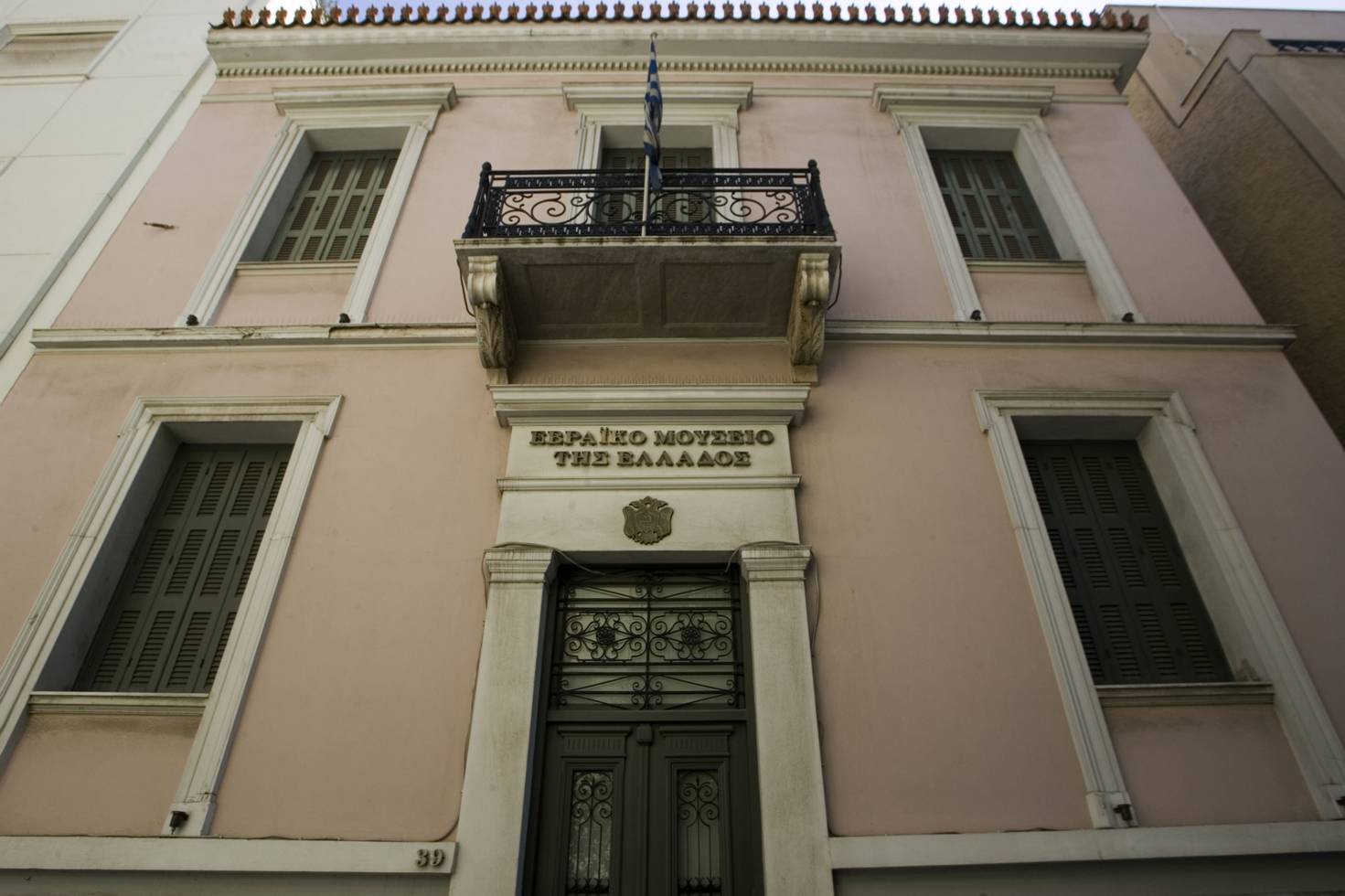
The idea of this museum has been consistent over time: to share the Greek Jewish experience with as many people as possible. And with this value, this museum does not separate itself from the buildings within its vicinity, maintaining the exterior walls of the existing 19th-century building [2]. It did, however, completely rebuild the interior to meet the demands of a modern Museum. In other words, the beauty of this museum is in the suspense held by the notion that to truly participate and get the satisfaction of visualizing history, one must be grounded and have humble intentions upon their entrance. And it is once we become more sensitive and aware of our intentions that we are able to enter into a building that spills sunlight from the glass domes, ascends us up a spiral stairway into ornate rooms, and surrounds us with thousands of years of historical treasure. Such attitudes are consistent with the roots and struggles of this museum to legitimize itself as such an important landmark in Athens, as the museum gradually grew into the massive location that it is today [3].
Description
History of Museum: To preserve the material culture of the Greek Jews, Nicholas Stavroulakis in 1977, established the Jewish Museum of Greece in Athens, Greece [4]. Although mighty in its pride, the actual museum figured to a small room next to the city’s synagogue. It housed objects salvaged from WWII, documents and manuscripts of the 19th and 20th centuries, and jewelry of the Jews of Thrace that had been seized by the Bulgarians in 1943 [5]. With continued support and gained legitimacy as a cultural center for the Greek Jews, this museum saw itself expand in its collection of rare books and publications, textiles, jewelry, domestic and religious artifacts, and soon began to attract the attention and admiration of visitors, researchers, and donors. In 1984, the physical museum soon expanded to a rented space occupying the 3rd floor of 36 [6], Amalias Avenue and acquired its legal status in 1989 [7], as a non-profit foundation with a seven-member Board of Directors. In catching up with its success to legitimize itself, the Board of Directors approved the purchase of a 19th-century neoclassical building, with the support of its Friends in Greece and abroad, the Jewish Community of Thessaloniki and the Central Board of Jewish Communities in Greece. With substantial financial support from the Greek Ministry of Culture and the Associations of its Friends, the old building was renovated and, in late 1997, twenty years after it first opened its doors to the public, the Museum moved to 39 Nikis street, its new address in the center of Athens [8]. Part of the library contains archival material pertaining to specific subjects, such as the Jewish Communities of Greece, World War II, and the Holocaust [9]. All this material (articles, theses, publications, correspondence, recent photographs, etc.) has been divided into large folders, which are continuously updated and available to the public. At this moment, the pride of Greek Jews finally matched the Museum’s setting.
History of Greek Jews: The heritage that this museum seeks to identify is wholly extensive. The term “Greek Jew” is overwhelming in itself, as it officiates any person of Jewish descent or faith that lives in or originates from the modern region of Greece. With a presence spanning as far back as the fourth century B.C.E., Jews in Greece have an extraordinary privilege that their ancestor’s foot tracks can be documented from a unique blend of Ottoman, Balkan and Hispanic influences [10]. This museum, with its artifacts, suggest that the term “Greek Jew” is very vague; as there are Sephardic Jews apart from Romaniote Jews, both arriving in Greece under different circumstances. We do know, however, that the majority of the Jews in Greece are Sephardim of whose ancestors had left Spain, Portugal, and Italy, after the 1492 expulsion of the Jews [11].
Greek Jews Today: Today, the Jewish community in Greece amounts to roughly 8,000 inhabitants, concentrated mainly in Athens, Thessaloniki, Larissa, Volos, Chalkis, Ioannina, Trikala, and Corfu [12]. In this day, Greek Jews generally have found a harmonious way to live side by side with Christian Greeks, the predominant cultural group [13]. In addition, many Greek Jews are now concerned and involved in the preservation of their heritage, and have constructed museums here in Athens, and are currently making great efforts to establish a Holocaust museum in the country [14].
Athens, Greece
© Mapbox, © OpenStreetMap
Sources
FOOTNOTES:
[1] Usque, Samuel. The Foundation for the Advancement of Sephardic Studies and Culture. New York: The Foundation, 1969, pg. 1. Accessed July 12, 2017
[2] (www.webarts.gr), Web Arts. "The History." Jewish Museum of Greece. Accessed July 13, 2017. http://www.jewishmuseum.gr/en/collection/library.html.
[3] Ibid.
[4] Plaut, Joshua Eli, Greek Jewry in the Twentieth Century, 1913-1983; Patterns of Jewish survival in the Greek Provinces Before and After the Holocaust, Fairleigh Dickenson University Press, 1996 p. 184
[5] "The History." Jewish Museum of Greece.
[6] Ibid.
[7] Ibid.
[8] Makris, A. "Holocaust Museum to Be Build [sic] in Greece - GreekReporter.com". GreekReporter.com. URL published 21 March 2017. Accessed July 14, 2017.
[9] (www.webarts.gr), Web Arts. "The Library." Jewish Museum of Greece. Accessed July 13, 2017. http://www.jewishmuseum.gr/en/collection/library.html.
[10] Usque, Samuel. The Foundation for the Advancement of Sephardic Studies and Culture. Pg.1
[11] Ibid.
[12] Short History Of The Jewish Communities In Greece (pdf), publicized by the Central Board of Jewish Communities in Greece. Accessed July 13, 2017.
[13] Current Activities of the Jewish Museum of Greece, The Central Board of Jewish Communities in Greece. URL published April 15, 2006. Accessed July 13, 2017.
[14] Makris, A. "Holocaust Museum to Be Build [sic] in Greece - GreekReporter.com".
IMAGES WAITING FOR PERMISSIONS:

http://www.mesogeia.net/athens/places/plaka/jewishmuseum_en.html
BIBLIOGRAPHY:
Usque, Samuel. The Foundation for the Advancement of Sephardic Studies and Culture. New York: The Foundation, 1969. Accessed July 13, 2017.
Plaut, Joshua Eli, Greek Jewry in the Twentieth Century, 1913-1983; Patterns of Jewish survival in the Greek Provinces Before and After the Holocaust, Fairleigh Dickenson University Press, 1996 p. 184
Battinou, Zanet. The Jewish community of Ioannina: A Journey Through Time. Athens: Jewish Museum of Greece, 2014.Accessed July 13, 2017.
(www.webarts.gr), Web Arts. "The Library." Jewish Museum of Greece. Accessed July 13, 2017. http://www.jewishmuseum.gr/en/collection/library.html.
(www.webarts.gr), Web Arts. "The Building." Jewish Museum of Greece. Accessed July 13, 2017. http://www.jewishmuseum.gr/en/collection/library.html
(www.webarts.gr), Web Arts. “Information.” Jewish Museum of Greece. Accessed July 15, 2017. http://www.jewishmuseum.gr/en/information/welcome.html.
Short History Of The Jewish Communities In Greece (pdf), publicized by the Central Board of Jewish Communities in Greece. Accessed July 13, 2017.
Current Activities of the Jewish Museum of Greece, The Central Board of Jewish Communities in Greece. URL published April 15, 2006. Accessed July 13, 2017.
Makris, A. "Holocaust Museum to Be Build [sic] in Greece - GreekReporter.com". GreekReporter.com. URL published 21 March 2017. Accessed July 14, 2017.